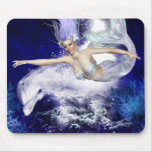
What are Mermaids?
Mermaids are legendary aquatic creatures with the head and upper body of a female human and the tail of a fish. Mermaids appear in the folklore of many cultures worldwide, including the Near East, Europe, Africa, and Asia. They are associated with perilous floods, storms, shipwrecks, and drowning — but also with beauty, grace, and the mysterious depths of the sea.
The male counterpart, the merman, is also a common figure in folklore and heraldry. Together, mermaids and mermen are sometimes referred to as merfolk or merpeople. Stories of mermaids date back thousands of years, with the first known mermaid legend originating in ancient Assyria around 1000 BC.
Did You Know?
Christopher Columbus reported seeing mermaids during his exploration of the Caribbean in 1493. He noted that they were "not half as beautiful as they are painted." What he likely saw were manatees — an encounter that has fascinated historians ever since.
History & Origins
The first known mermaid legend comes from ancient Assyria, around 1000 BC. The story tells of the goddess Atargatis, who transformed herself into a mermaid after accidentally killing her human shepherd lover. She jumped into a lake to take the form of a fish but the water would not conceal her divine beauty — so she took the form of a mermaid instead.
In ancient Greece, the Tritons (sea-gods with human upper bodies and fish tails) were widely depicted in art and mythology. The stories eventually gave rise to the image of the mermaid we recognize today.
Mermaid Names Around the World
| Culture | Name / Legend |
|---|---|
| Assyria | Atargatis — the first mermaid goddess |
| British Isles | Merrow — Irish/Scottish mermaid |
| Caribbean | Mami Wata — water spirit |
| China | Jiaoren — mermaid who cried pearl tears |
| Greece | Nereids, Tritons — sea deities |
| Russia | Rusalka — spirits of the drowned |
| Scotland | Selkies — seal-folk who shed their skins |
| Slavic | Rusalka — dangerous water nymph |
Symbolism & Meaning
Mermaids symbolize the duality of nature — they are simultaneously beautiful and dangerous, alluring and deadly. They represent the power of the ocean and the mystery of what lies beneath the surface. In many traditions they are omens: seeing one foretells a storm or disaster at sea, while in others they grant wishes or guide lost sailors home.
Mermaid Lore
- Mermaids can breathe both underwater and in open air.
- Seeing a mermaid is considered a bad omen by sailors — it signals an approaching storm.
- Mermaids are said to lure sailors to their deaths with beautiful singing.
- In some legends, mermaids can grant wishes to those who catch them.
- Mermaids are said to fall in love with human men and sometimes take human form to walk on land.
- In Scottish lore, Selkies can remove their seal skin to take human form.
- Mermaids are said to weep tears of pearl when separated from the sea.
Mermaids in Culture
Ancient Greece: The Nereids, sea nymphs who were daughters of Nereus, were often depicted as beautiful women with fish tails. They were generally benevolent helpers to sailors.
Hans Christian Andersen: "The Little Mermaid" (1837) popularized the romantic image of a mermaid who falls in love with a human prince, giving up her voice for legs.
British Isles: The Merrow of Irish and Scottish folklore were gentle mermaids who sometimes married humans, removing their "cohuleen druith" (magical cap) to live on land.
Africa & Caribbean: Mami Wata is a powerful water spirit worshipped across West Africa and the Caribbean, often depicted as a mermaid holding a snake.